
Introduction
As businesses expand, managing customer relationships and internal operations becomes more complex. Many organizations invest in digital solutions to improve efficiency, but choosing between a Customer Relationship Management (CRM) system and an Enterprise Resource Planning (ERP) system can be confusing. While both solutions help businesses grow, they serve different purposes.
Understanding the differences between CRM and ERP enables businesses to select the right technology based on their operational needs, business goals, and future growth plans. Whether you want to improve customer engagement or streamline internal processes, choosing the right solution is an important step toward digital transformation.
What Is CRM?
Customer Relationship Management (CRM) is designed to manage customer interactions throughout the sales journey. It helps businesses organize leads, track customer communications, manage sales opportunities, automate follow-ups, and improve customer service.
A CRM provides sales and marketing teams with valuable insights into customer behavior, helping them build stronger relationships and increase customer retention. According to Salesforce CRM, CRM systems help businesses improve customer satisfaction, sales productivity, and long-term customer relationships.
What Is ERP?
Enterprise Resource Planning (ERP) is a business management solution that integrates multiple business functions into a single platform. It connects departments such as finance, inventory, procurement, human resources, manufacturing, and operations, allowing organizations to manage resources more efficiently.
An ERP system provides real-time visibility into business processes, helping organizations improve productivity, reduce operational costs, and make informed business decisions. According to SAP ERP, ERP solutions enable businesses to streamline operations while supporting sustainable growth.
CRM vs ERP: What’s the Difference?
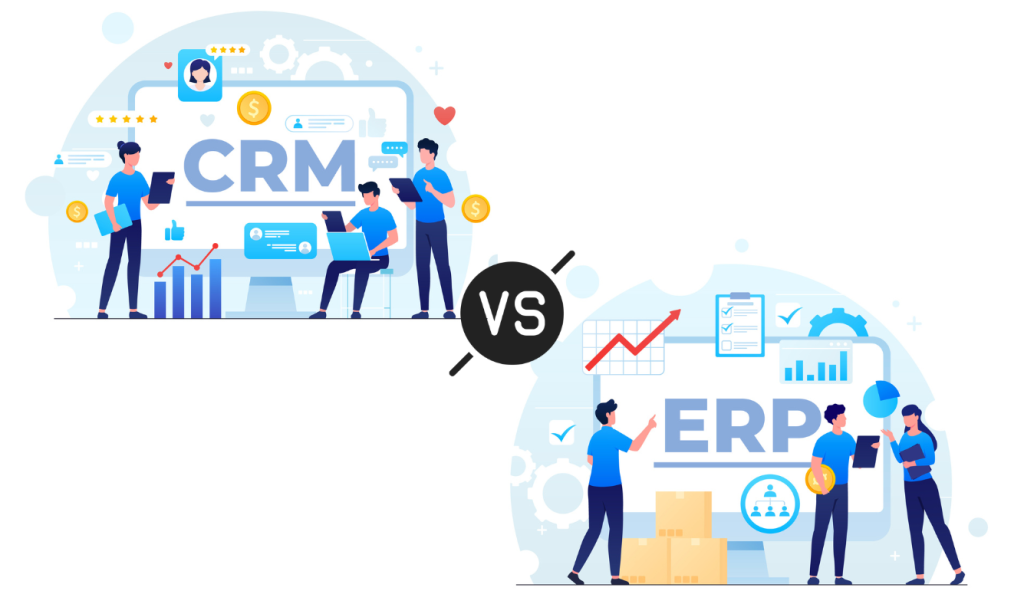
Although CRM and ERP are both business management solutions, their primary focus is different.
A CRM focuses on managing customers, sales activities, and marketing efforts. It helps businesses generate leads, improve customer communication, and increase sales conversions.
An ERP focuses on managing internal business operations such as finance, inventory, procurement, payroll, manufacturing, and supply chain management. It ensures that every department works together efficiently using a centralized database.
Many growing businesses implement both systems to improve customer relationships while optimizing internal operations.
When Should Your Business Choose a CRM?
A CRM solution is the right choice if your business wants to:
- Manage customer relationships effectively
- Track sales opportunities
- Improve lead management
- Automate customer follow-ups
- Increase sales productivity
- Enhance customer service
- Monitor marketing campaigns
Businesses with growing sales teams often benefit significantly from implementing a CRM platform.
When Should Your Business Choose an ERP?
An ERP solution is ideal when organizations need to:
- Manage finance and accounting
- Control inventory and procurement
- Automate payroll processes
- Improve operational efficiency
- Monitor business performance
- Connect multiple departments
- Scale business operations
ERP systems are particularly valuable for manufacturing companies, distributors, educational institutions, healthcare organizations, and enterprises managing complex business operations.
Can CRM and ERP Work Together?
Yes. Many organizations integrate CRM and ERP systems to create a unified business ecosystem.
A CRM manages customer interactions from lead generation to customer support, while an ERP manages internal operations such as finance, inventory, and human resources. When integrated, both systems provide a complete view of business performance, improve collaboration between departments, and eliminate duplicate data.
This integration enables businesses to make faster, more informed decisions while improving customer experiences.
Key Benefits of CRM and ERP
Businesses implementing CRM and ERP solutions can achieve several advantages.
- Better customer relationship management
- Improved operational efficiency
- Centralized business data
- Faster decision-making
- Automated workflows
- Better collaboration between teams
- Increased productivity
- Enhanced reporting and analytics
- Scalable business operations
- Sustainable business growth
Industries That Benefit
CRM and ERP solutions support organizations across multiple industries.
- Manufacturing
- Healthcare
- Retail and eCommerce
- Banking and Finance
- Education
- Logistics
- Real Estate
- Hospitality
- Government
- Information Technology
Every industry can benefit from improving customer management while optimizing internal business operations.
Best Practices for Choosing the Right Solution
Before selecting a CRM or ERP system, businesses should evaluate their current challenges, future growth plans, budget, and operational requirements. Choosing scalable software, providing employee training, and integrating systems with existing business processes ensures successful implementation.
Organizations should also review software capabilities regularly to maximize long-term business value.
Future Trends
Modern CRM and ERP platforms are becoming more intelligent through Artificial Intelligence, Machine Learning, predictive analytics, workflow automation, and cloud computing. These technologies help businesses automate routine tasks, improve forecasting, personalize customer interactions, and make data-driven decisions.
As digital transformation continues, integrated CRM and ERP solutions will become essential for building agile, efficient, and customer-focused organizations.
Why Choose Baap Company?
At The Baap Company, we help organizations simplify business management through intelligent CRM and ERP solutions tailored to modern business needs. Our Baap CRM helps businesses manage customer relationships, automate sales processes, and improve customer engagement, while our ERP Web + School Book App streamlines business operations, resource planning, and organizational workflows.
Our expertise in Software Engineering, AI Systems, Data Intelligence, and Digital Growth Infrastructure enables us to deliver scalable, secure, and future-ready enterprise solutions that support long-term business growth.
Conclusion
CRM and ERP systems are both essential business technologies, but they solve different challenges. A CRM helps businesses build stronger customer relationships and improve sales performance, while an ERP optimizes internal operations and resource management. Understanding your business priorities will help you determine which solution is the right fit.
Many growing organizations benefit from implementing both systems together, creating a connected digital environment that improves efficiency, collaboration, and decision-making. Choosing the right technology partner ensures successful implementation and long-term business success.
Contact The Baap Company
The Baap Company
Paregaon, Tal. Sangamner, Maharashtra – 422611, India
Phone: +91 9105868788
Email: info@baapcompany.com
Website: www.baapcompany.com